
Skip to content
Start a test
Light Motor Vehicle: Chapter 29 of 55

Light Motor Vehicle

55 chapters

  1. Pre-Trip Inspection, Exterior
  2. Pre-Trip Inspection, Interior
  3. Starting Procedure Manual
  4. Starting Procedure Automatic
  5. Signalling
  6. Signalling - hand signals (turning left)
  7. Signalling - hand signals (turning right)
  8. Signalling - hand signals (stop)
  9. Signalling - horn
  10. Clutch
  11. Moving off manual transmission
  12. Moving off automatic transmission
  13. Gear changing - up (manual transmission)
  14. Gear changing - down (manual transmission)
  15. Gear changing - up (automatic transmission)
  16. Gear changing - down (automatic transmission)
  17. Left Turn
  18. Reverse in Straight Line
  19. Parallel parking - to the right
  20. Parallel parking - to the left
  21. Parallel parking - to the right
  22. Incline start - manual transmission
  23. Incline start automatic transmission
  24. Mirrors Use
  25. Steering
  26. Speed Control
  27. Following other vehicles
  28. Lane changing
  29. Stopping - in traffic (manual transmission)
  30. Stopping - in traffic (automatic transmission)
  31. Stopping - for parking (manual transmission)
  32. Stopping - for parking (automatic transmission)
  33. Traffic control signal
  34. Overtaking - to the left of a hazard
  35. Overtaking - to the right of a hazard
  36. Being overtaken - on the left hand side
  37. Being overtaken - on the right hand side
  38. Intersections - turning left
  39. Intersections - turning right
  40. Intersections - proceeding straight
  41. Intersections - stop signs
  42. Intersections - yield signs
  43. Intersections - uncontrolled
  44. Intersections - traffic lights (flashing red)
  45. Intersections - traffic lights (steady red)
  46. Intersections - traffic lights (green)
  47. Intersections - traffic lights (flashing amber)
  48. Intersections - traffic lights (steady amber)
  49. Intersections - roundabout (traffic circle)
  50. Block pedestrian crossing - uncontrolled
  51. Level crossings - guarded
  52. level-crossings-unguarded
  53. Freeways - entering
  54. Freeways - exiting
  55. Freeways passing off and on ramps

Stopping – in traffic (manual transmission)
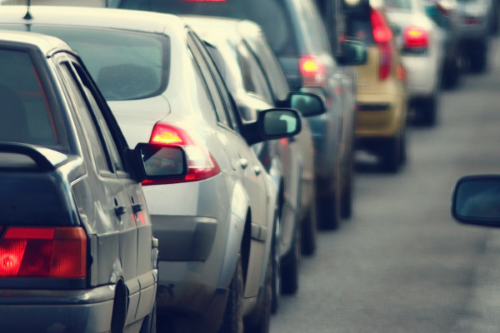
Stopping – in traffic (manual transmission)

Placeholder image

1. Check rear view mirror(s).

2. Decelerate.

3. Brake timeously smoothly and progressively without locking wheels and in complete control, keeping both hands on the steering wheel.

4. Select a lower gear, if required.

5. Disengage clutch just before vehicle is brought to a complete standstill, without laboring or stalling the engine.

6. Obtain and/or maintain clear space behind or alongside obstruction or road user, where applicable. (Approximately 4 – 5 metres behind the vehicle ahead)

7. Stop in accordance with road traffic signs, signals, rules and markings.

8. Apply parking brake, if necessary.

9. Select neutral, if necessary.

Note A:

The parking brake should be applied when stationary for any length of time or where there is a possibility of rolling, but may not be necessary depending upon traffic signs, stop/start progress of traffic and gradient of the road.

Note B:

Neutral should be selected when stationary for any length of time, but this may not be necessary depending on traffic signals and stop/start progress of traffic. Should the applicant stop for a shorter period than it would take to apply the parking brake and select neutral, he/she shall not be penalised for failing to apply the parking brake and selecting neutral.

Note C:

If the vehicle is equipped with a foot-operated parking brake, the sequence shall be to select neutral, with the service brake depressed and then to apply the parking brake.

Note D:

When coming to a stop, the brake pedal shall be depressed before disengaging the clutch in order to prevent coasting. This is not a requirement in stop-start traffic or when stopping on an incline.”,

Share:FacebookX