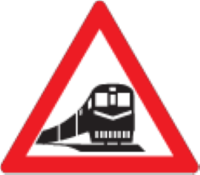
A train cannot swerve and needs a very long distance to stop. At a level crossing, the only way to stay safe is to look, listen and never enter unless you can clear the tracks completely.
Signs and signals at level crossings
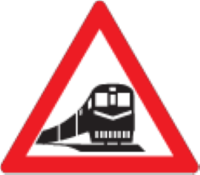
- Railway crossing (W318): warns of a railway crossing ahead. Slow down and look right and left for trains. If a train is coming, stop in time, but not within the railway reserve.
- Gate (W314): warns of a gate or boom across the road ahead. Slow down and be ready to stop if it is closing or closed.
- Stop sign (R1.1) or yield sign (R2): used at some crossings. Obey them exactly as you would at an intersection.
- Flashing red lights: a train is coming. You may not drive on until the lights stop flashing.
- Road markings: painted on the approach to warn you of the crossing ahead.
Guarded and unguarded crossings
A guarded crossing has booms, gates or warning lights. An unguarded crossing has none of these, so checking for trains is entirely up to you. The test uses both terms, so know the difference.
Crossing safely
- Check your mirrors and slow down as you approach.
- Look right and left along the tracks, and listen. Turn the radio down.
- Stop if a train is coming, if lights are flashing or if booms are moving.
- Only drive onto the crossing when there is room for your whole vehicle on the other side.
- Cross without stopping and, on an unguarded crossing, as close to a right angle as your lane allows.
Stopping near a crossing
You may not stop within the railway reserve at a level crossing. Never drive around a closed boom or under one that is lowering.
If your vehicle stalls on the tracks, get everyone out and well away from the line immediately, then call for help.
Test yourself
These questions come from the K53TestsOnline question bank. Choose an answer to see if you are right.